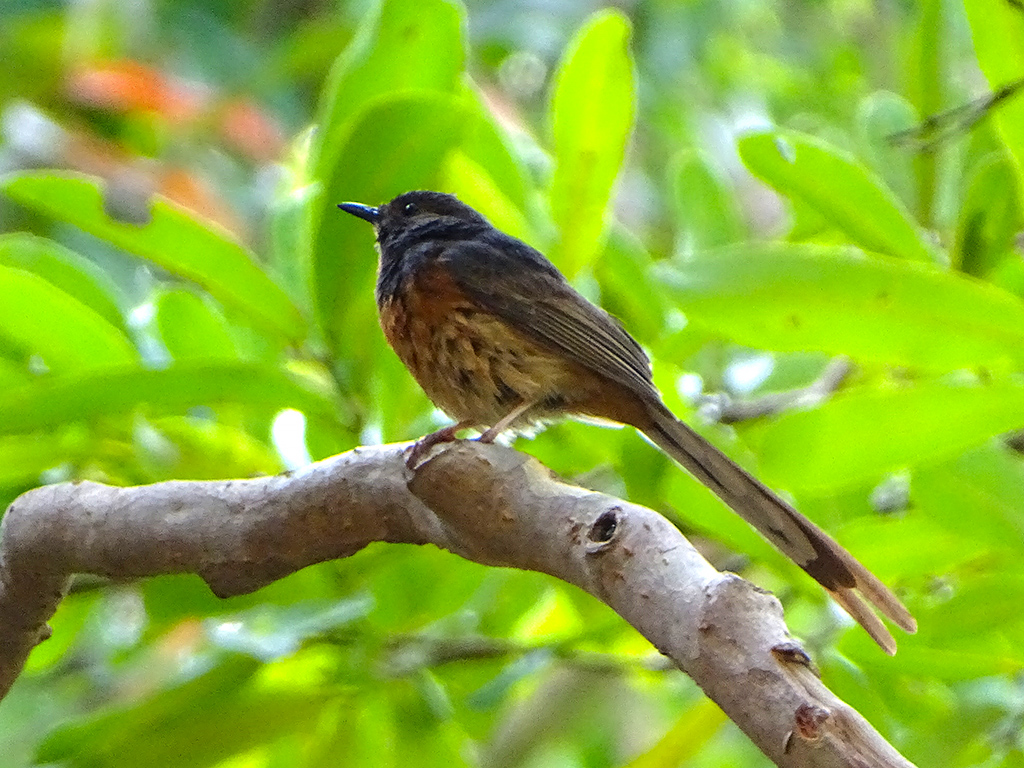
White-rumped shama
Muthyala Maduvu, Anekal,Karnataka
This is a female with dull plumage; it came this year to mate. It continuously collected nesting materials. Along with its male, it also flew here and there within a small radius, striking poses.
This Shama is another gem of Muthyala Maduvu. People who visit there are sure to spot it, even if they don't know the exact area where it resides. However, 70% of the time, it remains on the ground, amidst clutter, foraging for arthropods. The only one that stays consistently in the forest is an adult male with beautiful plumage. About 30% of the time, it perches in the open, which provides an excellent opportunity for photographers or birdwatchers to take photos. This Shama is very famous for its beautiful, long, and loud call. When it calls, you'll want to watch it, as it produces many tones simultaneously. Sometimes, it even mimics other birds. The most beautiful part of this bird is its long tail with a white rump. When it calls or sits on a clear perch, it continuously erects its tail.
Information of White-rumped shama
| IUCN (International Union for Conservation of Nature): | Least Concern |
|---|---|
| Approximate size(adult): | Length about 23–28 cm, including a long tail; weight around 28–34 g. Slender songbird with glossy black upperparts in males, chestnut underparts, and a distinctive white rump and outer tail feathers. Females are duller brown-grey. |
| Resident/ Migrate from: | Resident species across South and Southeast Asia, including India, Nepal, Sri Lanka, Thailand, and Indonesia. |
| Migrate to: | Non-migratory; mostly sedentary, though may shift locally with habitat changes or breeding conditions. |
| Breeding season: | Usually February to July in India and the Himalayas, extending up to August in some regions. |
| Breed in: | Nests in tree hollows, dense shrubs, bamboo clumps, or occasionally man-made structures. The nest is cup-shaped, made of roots and grass. Clutch size is typically 3–5 eggs. Both parents share incubation and feeding duties. |
| Habitat: | Prefers dense forests, bamboo thickets, forest edges, shaded gardens, and plantations. Often found near forest streams or undergrowth in humid areas. |
| Diet: | Omnivorous: feeds on insects, fruits, grains, nectar, and small vertebrates. Forages mostly on the ground or low vegetation, often in pairs or small groups. |