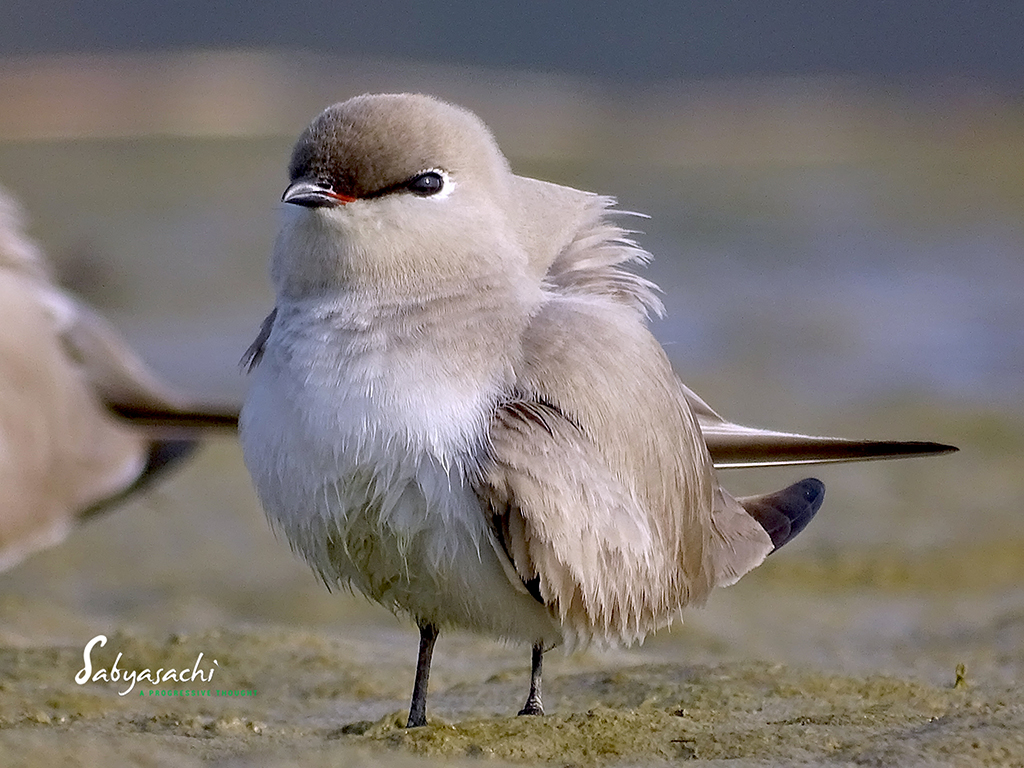
Small pratincole
Nayachar, Katwa,West Bengal
We all know how cute this bird is. As a winter migrant, it flies over in huge flocks and starts living on sandbanks of rivers or coastal areas. When they are flying around, you will see a black spiral wave moving like bees in the sky. Soon, they land again on the ground. To observe this cute little bird up close, you have to crawl to gain their trust. You wonβt believe how close you can get to them and take pictures. If the sandbank is by the riverside, it gets wet and compact. But if they find a coastal area where the sandbank is dry, they dig into it and rest under the sun. This behavior also provides great camouflage, as they remain still to protect themselves from predators. In the second picture, you can see how only their heads are visible.
Information of Small pratincole
| IUCN (International Union for Conservation of Nature): | Least Concern |
|---|---|
| Approximate size(adult): | Measures about 16–18 cm in length with a wingspan of 40–45 cm; small, compact with pale grey upperparts, white underparts, and short tail. |
| Resident/ Migrate from: | Largely resident across India, Sri Lanka, Nepal, and Myanmar, though northern populations may disperse locally outside the breeding season. |
| Migrate to: | Some seasonal movement within South and Southeast Asia, but not long-distance migratory. |
| Breeding season: | Breeds mainly from February to June in India, often synchronized with the dry season when river sandbanks are exposed. Nests are shallow scrapes on sand or gravel, with 2–3 eggs laid directly on open ground. |
| Breed in: | Prefers sandbanks, gravel bars, and open riverbeds of major rivers and lakes. |
| Habitat: | Found around rivers, lakes, reservoirs, and coastal lagoons with exposed sandy or gravelly areas; often in open, flat, arid zones near water. |
| Diet: | Feeds mainly on insects, especially beetles, termites, and flying ants, caught in flight or from the ground near water. |