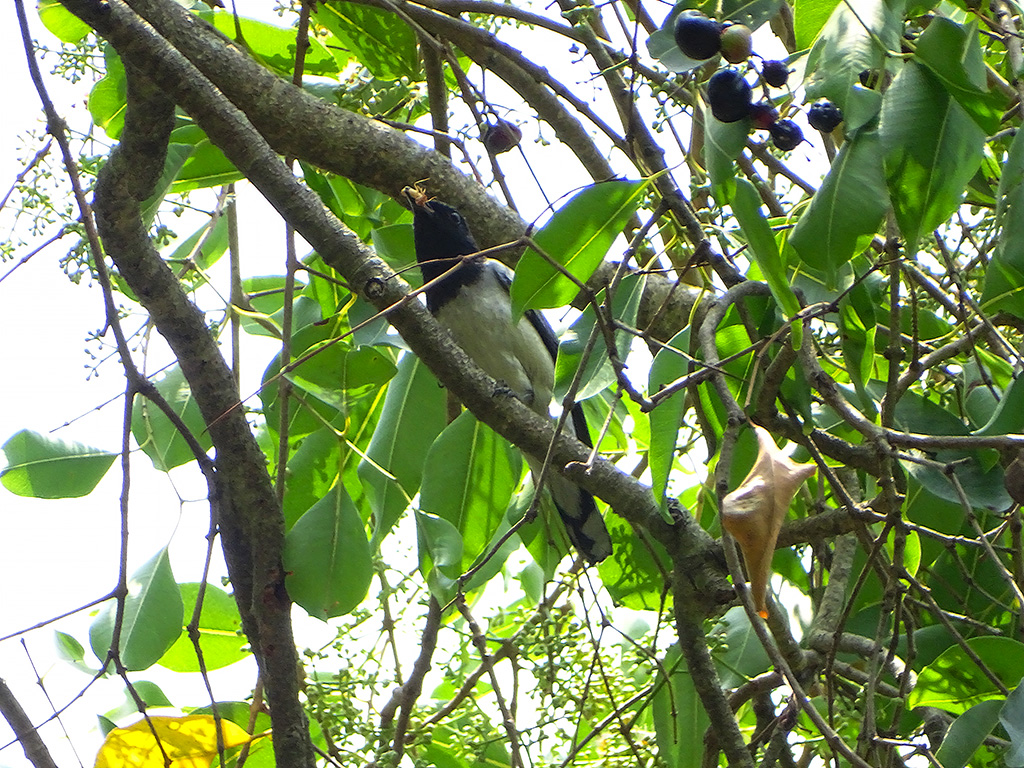
Black-headed cuckooshrike
Cauvery Wildlife Sanctuary,Karnataka
Valley School,Karnataka
I remember taking a nature walk led by Chandu Bandi inside Valley School. During that walk, we spotted a cuckoo shrike sitting on the top branch above our heads, not moving at all. I have never seen any cuckoo shrike sit so still, even though it is not a particularly shy bird. However, it was probably the closest I've ever seen a cuckoo shrike sit so far.
Bannerghatta National Park,Karnataka
The cuckoo shrike is a sturdy bird, primarily black, white, and grey in color. Its size is similar to that of a common myna, or slightly larger. One day, I spotted this bird inside the Bannerghatta Butterfly Park. It was almost afternoon when I came out of the 3 Dome Hall after watching the butterflies and began searching for the Blue-bearded bee-eater. Suddenly, this cuckoo shrike appeared and started hopping on a tree branch. It was not very shy and allowed me time to photograph it until the tree branch became a threat. The bird's beautiful color combination was incredibly attractive, even though the lighting conditions were not ideal. But there was no need to worry, as we can find this bird here and there.
Information of Black-headed cuckooshrike
| IUCN (International Union for Conservation of Nature): | Least Concern |
|---|---|
| Approximate size(adult): | Length about 20–22 cm; weight around 30–40 g. A medium-sized bird with slaty-grey upperparts, black head and throat in males, and paler grey or whitish underparts. Females are duller with a greyish head and faint streaking below. |
| Resident/ Migrate from: | Resident species found across the Indian subcontinent, Sri Lanka, and parts of Southeast Asia; mostly sedentary, though some populations make local seasonal movements. |
| Migrate to: | Generally non-migratory, but may shift locally in response to food availability or monsoon patterns. |
| Breeding season: | March to August in India, varying by region. Courtship involves aerial chases and soft calls. |
| Breed in: | Builds a small cup-shaped nest made of grass, fibers, and cobwebs, placed on tree branches. Lays 2–3 eggs, which are incubated by both parents. Both male and female share feeding duties. |
| Habitat: | Inhabits open forests, wooded hills, groves, and well-wooded gardens. Prefers dry deciduous forests but is also found in secondary growth and cultivated landscapes with trees. |
| Diet: | Primarily insectivorous, feeding on caterpillars, beetles, and other insects gleaned from foliage. Occasionally eats berries and small fruits, especially outside the breeding season. |